



VIKAS SHARMA
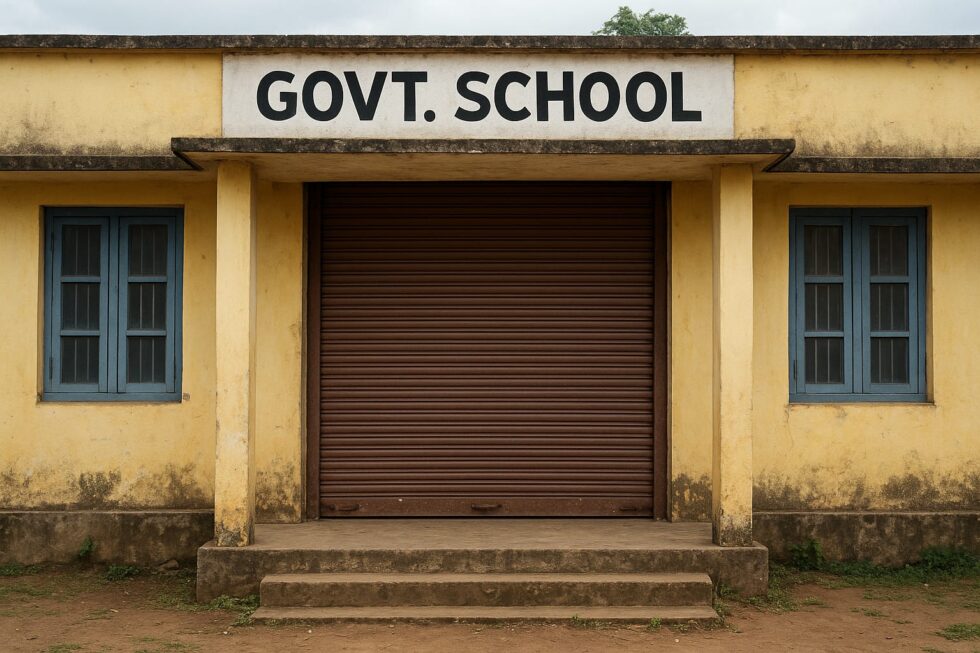
JAMMU, SEPT 14: In what experts are calling a wake-up call, the Union Territory of Jammu and Kashmir has seen 4,380 government schools either closed or discontinued over the last five years.
According to official data from the Ministry of Education, presented in Parliament in August 2025, the number of schools in J&K has fallen sharply from 23,165 in 2019-20 to 18,785 in 2023-24 — a decline that threatens to push already vulnerable communities further to the margins.
The steep drop is particularly alarming between 2021-22 and 2022-23, when the total plunged from 23,173 to 18,785 in just one year. For three years prior, the number of schools had remained relatively steady, but this sudden fall signals deeper systemic problems.
School education experts warn that declining enrollments, challenges in maintaining infrastructure, and administrative restructuring are contributing to this crisis.
“This is more than just numbers. Every school closure is a child losing a classroom, a teacher, and a chance at education. Without urgent intervention, Jammu & Kashmir could see a widening gap in educational access, further deepening inequality”, experts said
They stressed that renewed efforts are essential — upgrading facilities, improving teacher-student ratios, and leveraging digital learning platforms to bring education closer to those living in remote corners.
“The sharp decline in schools across J&K is a worrying sign. Education access must be safeguarded if the region’s developmental aspirations are to be achieved.
Government schools in remote, hilly, and conflict-hit areas are often the only educational lifeline for children from economically weaker sections. The closures now raise fears that thousands of students may be left without access to basic schooling”, experts maintained.
The situation in J&K stands in stark contrast to progress in other states. Bihar, for example, expanded its school network from 72,610 in 2019-20 to 78,120 in 2023-24, reflecting targeted efforts to strengthen educational infrastructure. Rajasthan too recorded growth, from 67,660 to 70,233 schools in the same period.
However, other states with geographical and infrastructural challenges mirrored J&K’s experience. Madhya Pradesh saw its schools decline from 99,411 to 92,439, Odisha from 53,260 to 48,671, and Arunachal Pradesh — located in difficult terrains — from 3,056 to 2,847 schools. Urban states like Delhi (2,767 to 2,693) and Goa (827 to 789) reported only minor decreases.
The central government during a reply maintained that schemes like Samagra Shiksha, which integrates earlier programs such as Sarva Shiksha Abhiyan and Rashtriya Madhyamik Shiksha Abhiyan, are working to support educational development.
These schemes aim to open and strengthen schools, build classrooms, and provide financial assistance to improve learning outcomes.
“For regions where building new schools is not viable — such as sparsely populated or hilly areas — transport facilities are provided at an average cost of ₹6,000 per child per annum up to Class X. Additionally, Netaji Subhash Chandra Bose Awasiy Vidyalayas have been set up in conflict-affected areas to ensure uninterrupted education for students from marginalized communities”, it added.
Programs like PM-JANMAN and Dharti Aaba Janjatiya Gram Utkarsh Abhiyan (DAJGUA) also aim to support Particularly Vulnerable Tribal Groups and underserved Scheduled Tribe populations, but experts warn that much more needs to be done.