




VIKAS SHARMA
JAMMU, AUG 27: What climate experts had predicted three to four decades ago about the devastating impacts of global warming is now unfolding as a harsh reality in Jammu and Kashmir. The fragile Himalayan ecosystem is reeling under extreme weather events, with landslides, cloudbursts, and incessant rainfall wreaking havoc on lives, livelihoods, and infrastructure. The prevailing spell of torrential rains across almost all parts of the Union Territory has pushed the situation to catastrophic levels.
At least 30 people lost their lives after heavy rains triggered a massive landslide near the Vaishno Devi shrine in Katra. SSP Reasi, Paramvir Singh, confirmed the death toll to news agency ANI. Earlier, Union Home Minister Amit Shah termed the incident “extremely tragic” and said he had spoken to Chief Minister Omar Abdullah and Lieutenant Governor Manoj Sinha, assuring full support from the Centre.
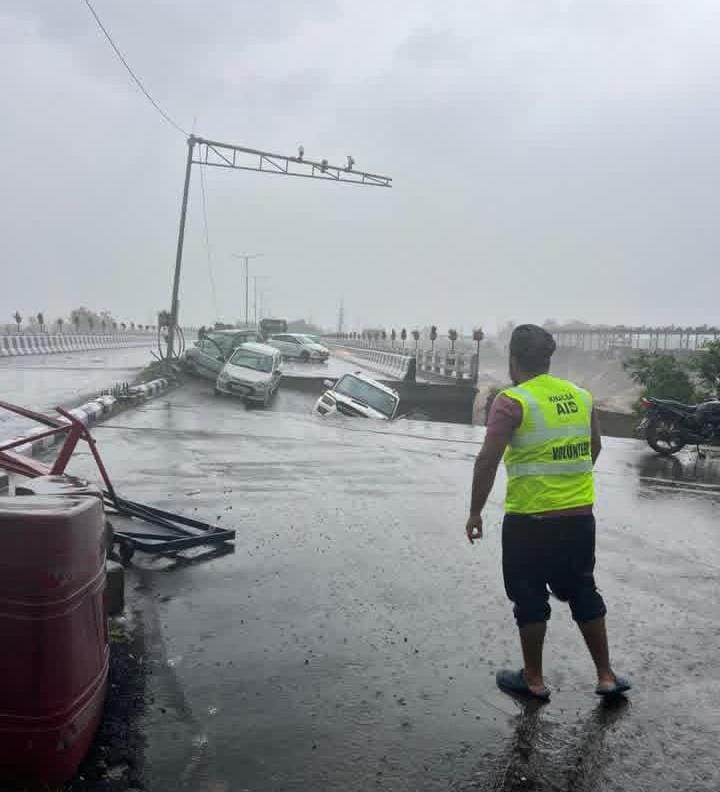
Continuous heavy rainfall since Monday evening has left behind a trail of destruction, damaging three bridges over river Tawi in Jammu and Devak at Vijaypur, while the mighty Chenab and heavily flooded Tawi rivers were reported flowing 10 feet above the danger mark by Tuesday evening.
Road connectivity has been severely disrupted, with the Jammu-Srinagar National Highway, Batote-Doda-Kishtwar road, and Mughal Road among several others closed due to multiple landslides. At many stretches, roads have sunk or washed away, halting restoration work amid relentless downpour. More than 5,000 vehicles are stranded between Jammu and Srinagar as well as on Dhar Road (Udhampur-Manwal) and Samba-Mansar Road.
According to Director Meteorological Department Srinagar, Dr Mukhtar, Jammu recorded 248 mm of rainfall in the past 24 hours till 5:30 pm, breaking a 99-year-old record. The previous highest rainfall of 228.6 mm was recorded on August 5, 1926, while the second highest of 218.4 mm was reported on August 23, 1996.
Rainfall figures across the region painted a grim picture: Katra received 190.6 mm, Reasi 175.5 mm, Samba 148.5 mm, Kathua 104 mm, Udhampur 101 mm, Doda 133 mm, Kishtwar 49 mm, Ramban 43 mm and Banihal 50 mm in the past 24 hours. In Doda district, two people were killed when houses collapsed due to incessant rains, while two others lost their lives in a cloudburst and subsequent flash floods in Bhallessa and Bhaderwah. Another flash flood struck Tanta village following a cloudburst.
Over the past few years, Jammu and Kashmir has witnessed a sharp escalation in climate-related disasters. Torrential rains have frequently triggered landslides, cutting off vital road links such as the Jammu-Srinagar National Highway—the lifeline of Kashmir. Once considered rare, cloudbursts are now occurring with alarming regularity, devastating villages and causing extensive damage to life and property.
Environmentalists warn that unless urgent climate adaptation and disaster management measures are put in place, the Himalayan region could face even greater catastrophes in the years to come.